
Note
Go to the end to download the full example code.
Geometry segmentation of a layered medium#
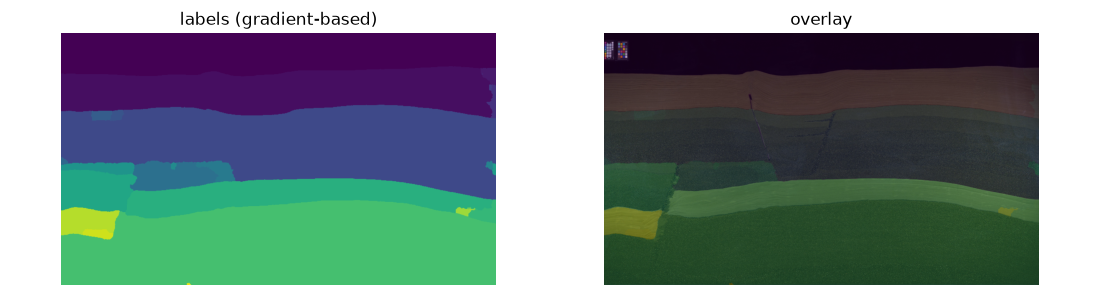
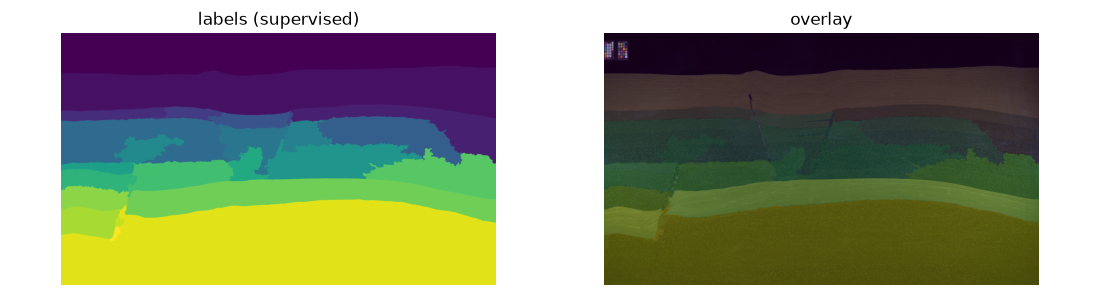
Segmentation splits an image of a multi-layered porous medium into labelled regions. DarSIA wraps a watershed workflow; this example contrasts a fully gradient-based run with a supervised run seeded by marker points.
from pathlib import Path

import matplotlib.pyplot as plt
import numpy as np

import darsia

path = Path("..") / "images" / "baseline.jpg"
image = darsia.imread(path, dim=2)

# Crop away the shadowed borders to keep the focus on the workflow.
image = image.subregion((slice(0, None), slice(55, 3140)))
Warning: No exif metafile found. Please install ImageMagick to read metadata from terminal.
Gradient-based segmentation. The config holds the watershed tuning parameters;
set verbosity=True to see the intermediate quantities.
config = {
    "median disk radius": 20,
    "rescaling factor": 0.3,
    "markers disk radius": 10,
    "threshold": 20,
    "gradient disk radius": 2,
}
labels = darsia.segment(
    image,
    markers_method="gradient_based",
    edges_method="gradient_based",
    verbosity=False,
    **config,
)

fig, axes = plt.subplots(1, 2, figsize=(11, 3))
axes[0].imshow(labels.img)
axes[0].set_title("labels (gradient-based)")
axes[1].imshow(image.img)
axes[1].imshow(labels.img, alpha=0.3)
axes[1].set_title("overlay")
for ax in axes:
    ax.set_axis_off()
fig.tight_layout()
/opt/hostedtoolcache/Python/3.12.14/x64/lib/python3.12/site-packages/skimage/util/dtype.py:578: UserWarning: Downcasting int32 to uint8 without scaling because max value 65 fits in uint8
  return _convert(image, np.uint8, force_copy)
/home/runner/work/DarSIA/DarSIA/src/darsia/utils/segmentation.py:515: FutureWarning: `binary_dilation` is deprecated since version 0.26 and will be removed in version 0.28. Use `skimage.morphology.dilation` instead. Note the lack of mirroring for non-symmetric footprints (see docstring notes).
  mask = skimage.morphology.binary_dilation(
/home/runner/work/DarSIA/DarSIA/src/darsia/utils/segmentation.py:433: UserWarning: Cleanup in the segmentation has removed labels.
  warn("Cleanup in the segmentation has removed labels.")
Supervised segmentation. One marker point per region guides the watershed, and a mask hides the colour checker in the top-left corner.
mask = np.ones(image.shape[:2], dtype=bool)
mask[slice(0, 220), slice(0, 200)] = False

config = {
    "marker_points": np.array(
        [
            [100, 1600],
            [400, 1600],
            [560, 760],
            [620, 1260],
            [550, 1970],
            [630, 365],
            [690, 1225],
            [620, 1990],
            [560, 710],
            [775, 1810],
            [615, 1610],
            [830, 570],
            [940, 1320],
            [890, 1775],
            [940, 360],
            [1000, 240],
            [1130, 165],
            [1325, 170],
            [1010, 680],
            [1020, 2650],
            [1075, 1530],
            [1325, 405],
            [1400, 385],
            [1350, 1320],
        ]
    ),
    "region_size": 20,
    "mask scharr": mask,
}
labels_supervised = darsia.segment(
    image, markers_method="supervised", edges_method="scharr", **config
)

fig, axes = plt.subplots(1, 2, figsize=(11, 3))
axes[0].imshow(labels_supervised.img)
axes[0].set_title("labels (supervised)")
axes[1].imshow(image.img)
axes[1].imshow(labels_supervised.img, alpha=0.3)
axes[1].set_title("overlay")
for ax in axes:
    ax.set_axis_off()
fig.tight_layout()
plt.show()
Total running time of the script: (0 minutes 28.097 seconds)